
Everything is Connected: Five Ways Our Treatment of Animals Impacts the Earth
By Kristin Dunn
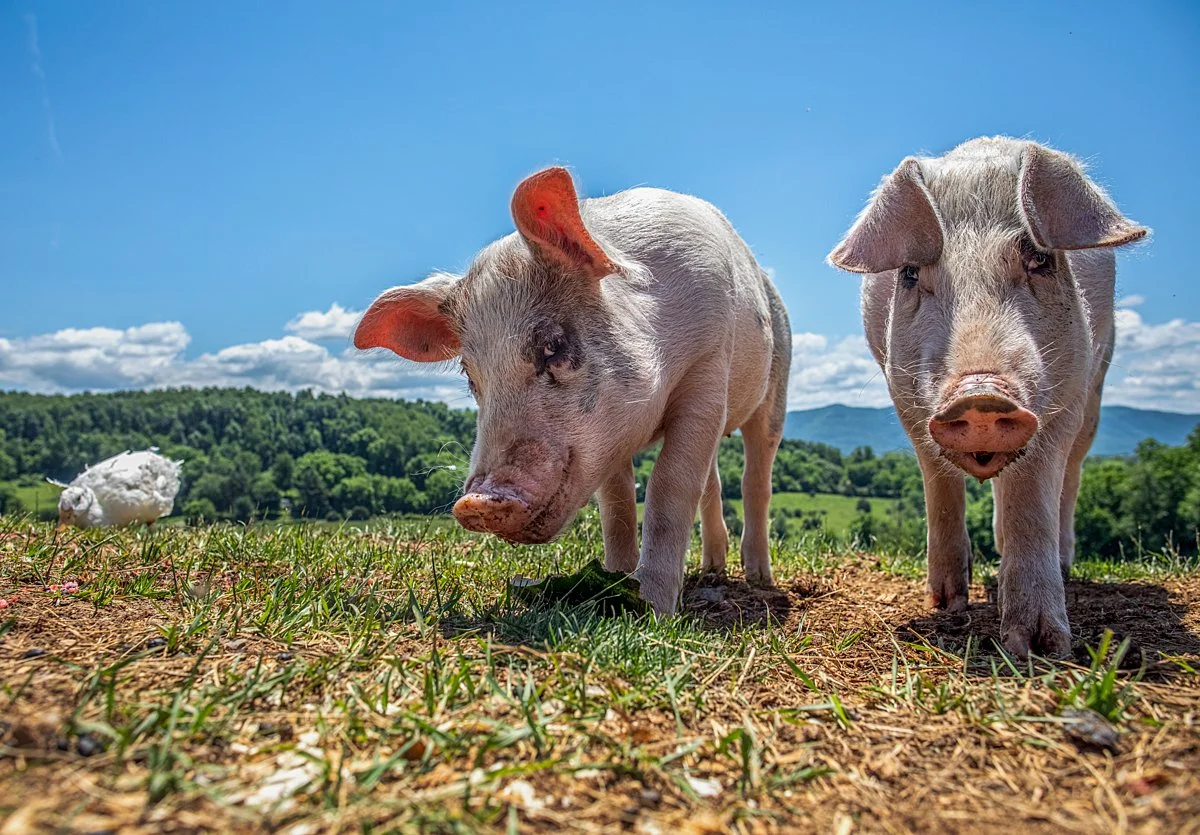
Clementine (L) and Winston (R) fell off transport trucks as piglets, in two different states, falls that saved their lives. At Gentle Acres Animal Haven in Virginia, the two live in sanctuary and are “inseparable friends.” Credit: Mary Shannon Johnstone / We Animals
The concept of integral ecology reminds us that everything in creation is connected. It’s no surprise, then, that our abuse and mistreatment of one part of creation wreaks havoc across the entire web of relationships. We cannot expect to relegate billions of living beings to a life of suffering without facing a spiritual and ecological reckoning.
In the Catechism of the Catholic Church, we read, “Each of the various creatures, willed in its own being, reflects in its own way a ray of God's infinite wisdom and goodness. Man must therefore respect the particular goodness of every creature, to avoid any disordered use of things which would be in contempt of the Creator and would bring disastrous consequences for human beings and their environment” (CCC, 339).
Today, factory farming stands in clear “contempt of the Creator” - disregarding the “goodness of every creature” and instead treating them like commodities. And indeed, the Catechism’s prediction of “disastrous consequences” is obvious in the toll this is taking on our environment. Since those words were written, factory farming has expanded to now account for 99% of farmed animals.
Credit: Molly Condit / LEAP / We Animals
We need an urgent conversion of heart, an awakening to the plight of our fellow creatures, and a collective commitment to change. By answering the cry of God’s creatures, we simultaneously answer the cry of the earth. Here are five ways they are linked:
1. Animal agriculture pollutes our waterways.
Animal agriculture is the leading polluter of U.S. rivers and streams, according to the ASPCA. The group notes, “It's estimated that every minute, nearly 2 million pounds of excrement are produced by animals” on factory farms.
2. Slaughterhouses produce an alarming amount of nitrogen, a key water pollutant.
According to the Center for Biological Diversity, “On average a U.S. slaughterhouse may produce, in a single day, as much nitrogen pollution as untreated sewage in a city of 14,000 people.” The group states that slaughter facilities “discharge water contaminated with blood, oil, grease and fats, ammonia, dangerous fecal bacteria, and excrement.”
3. Animal agriculture is an important driver of climate change.
Globally, animal agriculture accounts for 14.5% of all human-caused greenhouse gas emissions.
4. Animal agriculture is a major cause of global deforestation and habitat loss.
According to research from Our World in Data, cattle farming alone caused 41% of global deforestation and 72% of deforestation in Brazil from 2005-2013.
5. A plant-based future could restore the earth and feed the world.
A study published by the University of Oxford found that “without meat and dairy consumption, global farmland use could be reduced by more than 75% – an area equivalent to the US, China, [Europe] and Australia combined – and still feed the world.”
The case is clear: if we respect the goodness of each creature and respect God’s creation, we can feed the world, restore our earth, and build the harmonious future we are called to help create. We have an abundance of resources, but we must each do what we can to push for change. This includes choosing plant-based foods and raising awareness within our communities. The animals, the earth, and our future depend on it.