
Saint Kateri Tekakwitha: Living in Harmony with Creation
by Franchesca Alamo
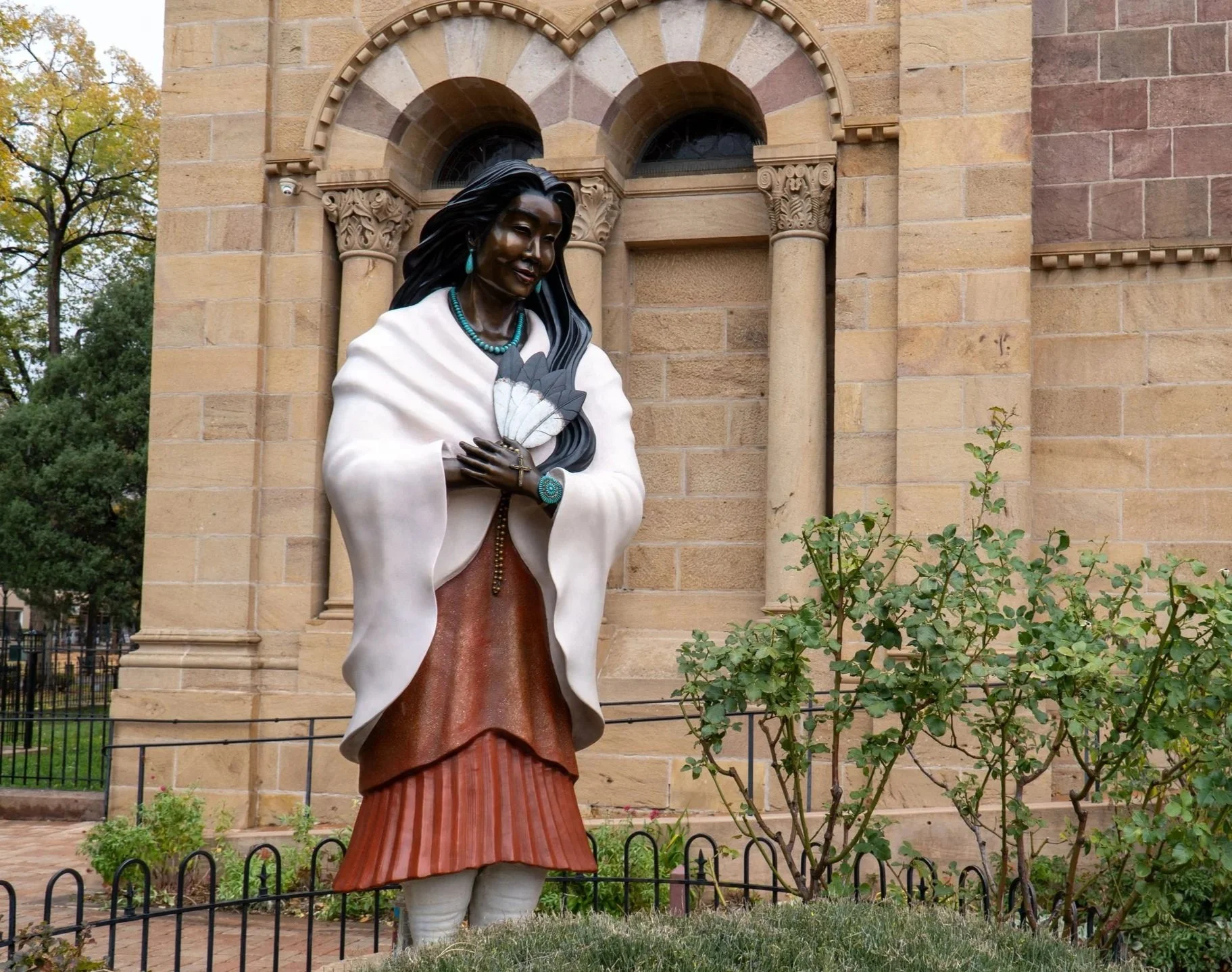
Today, we remember and revere St. Kateri Tekakwitha (1656–1680), the first Native American person to be canonized by the Catholic Church; the protectress of Canada; and the patroness of environmentalism, ecology, and all Native American and First Nations peoples.
To honor St. Kateri throughout the year, we encourage you to consider praying a novena to this great saint or exploring the Saint Kateri Conservation Center's certified habitat program and Catholic ecological scholarship resources.
The Church, as preserver and promulgator of thousands of saints’ biographies and mythologies, offers to the faithful countless examples of Christlike lives worth imitating and, often, emphasizes how well each bore their suffering. I can understand why this is. Kateri herself was intimately acquainted with suffering, as the historical record shows: At only four years of age, a smallpox outbreak stole away her immediate family, her eyesight, and her physical beauty. She covered her head with a blanket until she died, as if to hide the scars, both visible and invisible, left by this terrible wound of colonization. During her adolescence, her fellow Mohawks pressured her relentlessly to marry a local boy and to repudiate her Catholic faith; when their coercive attempts failed, some resorted to the infliction of physical torture. So she fled from her village in now-Upstate New York to a Christian mission near Montréal—a pilgrimage of nearly 200 miles, made on foot. Four years later, her frail body finally succumbed to her acts of extreme self-mortification and to the agonies of tuberculosis.
As Catholics, and as advocates for the animals, we must resist the urge to bypass the mystery of suffering. Across every era, and across countless species, that mystery confounds, devastates, indicts, and moves us, and our Church, understandably, never diverts her gaze from the Cross. On this feast day, however, I take a step back from the tapestry before me, and I study not Kateri’s stoicism, orthodoxy, or asceticism—but the single thread that is woven brightly through her every choice: that is, her unceasing cooperation with grace.
In tracing that thread, I offer the following prayer in remembrance of her:
St. Kateri, patroness of all Native American and First Nations peoples:
Your final words were “Jesos Konoronkwa” (“Jesus, I love you”). These words echo through your past: though you were nearly blind, you never failed to recognize Jesus Christ when He was in your midst. And these words echo endlessly before us, blessing every rodent and every whale, every sapling and every mountain, every breath of air and every dark and open sea.
In your brief time on Earth, you challenged us to love this planet on which your Bridegroom walked. You healed the sick and the elderly, relying on the wisdom you inherited from your people with the help of the Holy Spirit. You sought transcendence in the Mass, but also in the wilderness. You fastened sticks together to form small crosses that you then placed all around you, praying in your secret dirt-and-tree cathedrals, accompanied by choirs of songbirds and archangels together. You turned your veiled face from the poisoned wells of patriarchy, conformism, and human desire, drinking deeply instead from the “Living Water” (Jn. 4:10).
From the dawn of our nation’s history, and from the heavens in which linear time collapses, your soul still loudly proclaims the thesis of the Gospels: that the destiny of the human race is not in self-betrayal, but in self-sacrifice; not in conquest, but in surrender; not in dominion, but in humility; and not in merit, but in a love no one can earn.
And though you once withdrew in fear from the stares of others, the Church you loved calls back to you, straining to see your beautiful face. Our Lily of the Mohawks, gaze upon us; remember us; pray for us.
Franchesca Alamo is a corporate attorney based in Chicago, IL with a B.A. in English (‘15) and a J.D. ('22) from the University of Chicago. She shares a home and life with her fiancé, José, and their tortoiseshell cat, Beatrice, and volunteers regularly at Old Saint Patrick’s Church and the Anti-Cruelty Society.