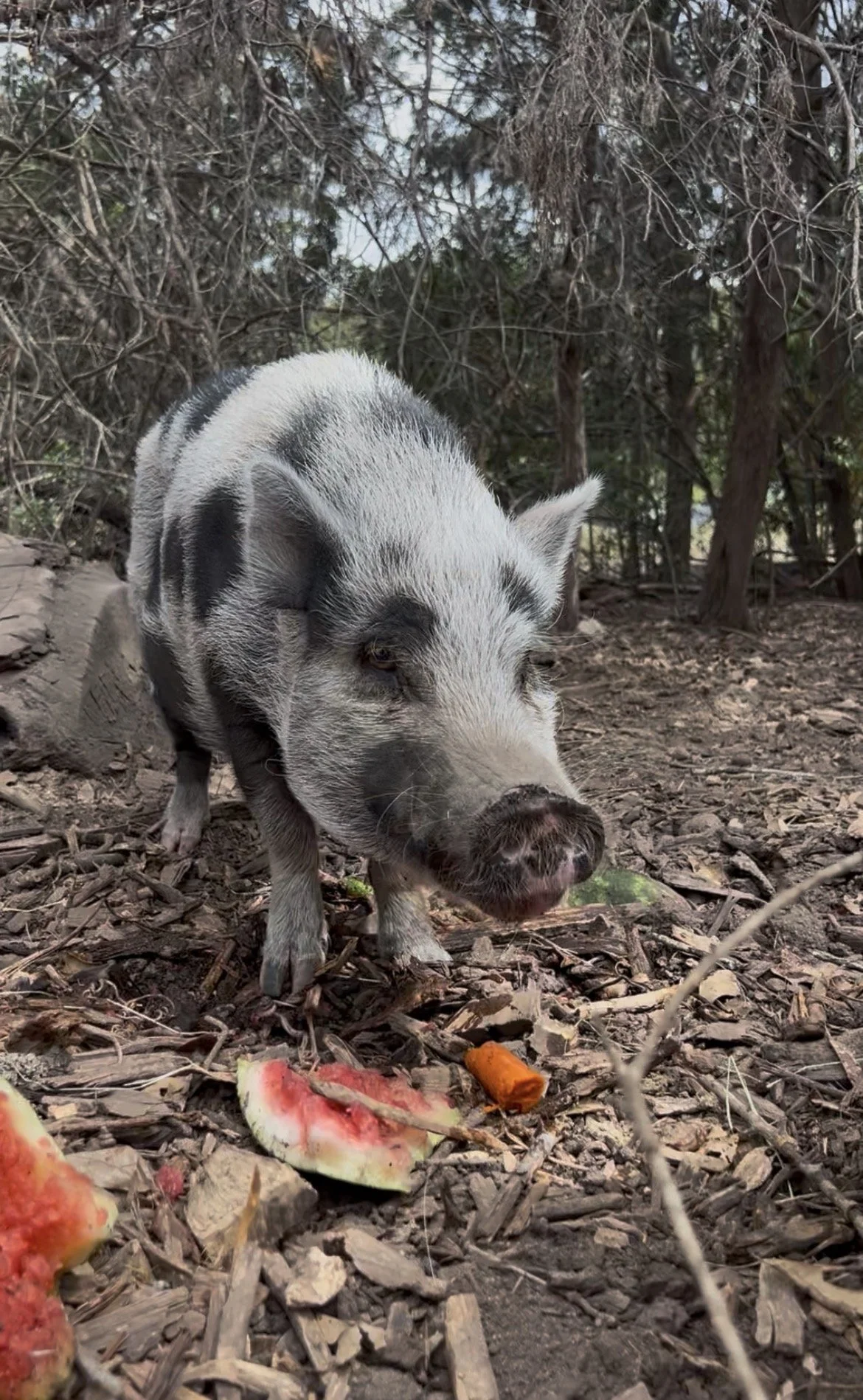
by Kristin Dunn

For many, Labor Day weekend is synonymous with pool parties, cookouts, and time with friends. The same is apparently true for more than 200 rescued pigs in central Texas, who marked the official end of summer with mud baths, watermelons galore, and a bevy of adoring visitors.
I attended the Central Texas Pig Rescue’s Annual Watermelon Smash this year and got to witness the fun firsthand. I met dozens of pigs, toured their incredible sanctuary, and was reminded of the power of caring about each and every one of God’s creatures.
Each an Individual
Animal sanctuaries offer potent lessons in animals’ individuality. Sentient beings once treated like commodities are finally respected as the thinking, feeling individuals they are – each one created by, and loved by, God.
Sanctuary visitors discover that, just like dogs and cats (and us!), rescued animals have distinct personalities. They’re expressive, show clear preferences, remember sanctuary staff or volunteers, and have friends. They like to play. They’re smart, determined, and self-directed. Some seek out the company of humans or other animals; others are still learning how to trust. And, while some like to be the center of attention, others prefer their own space.
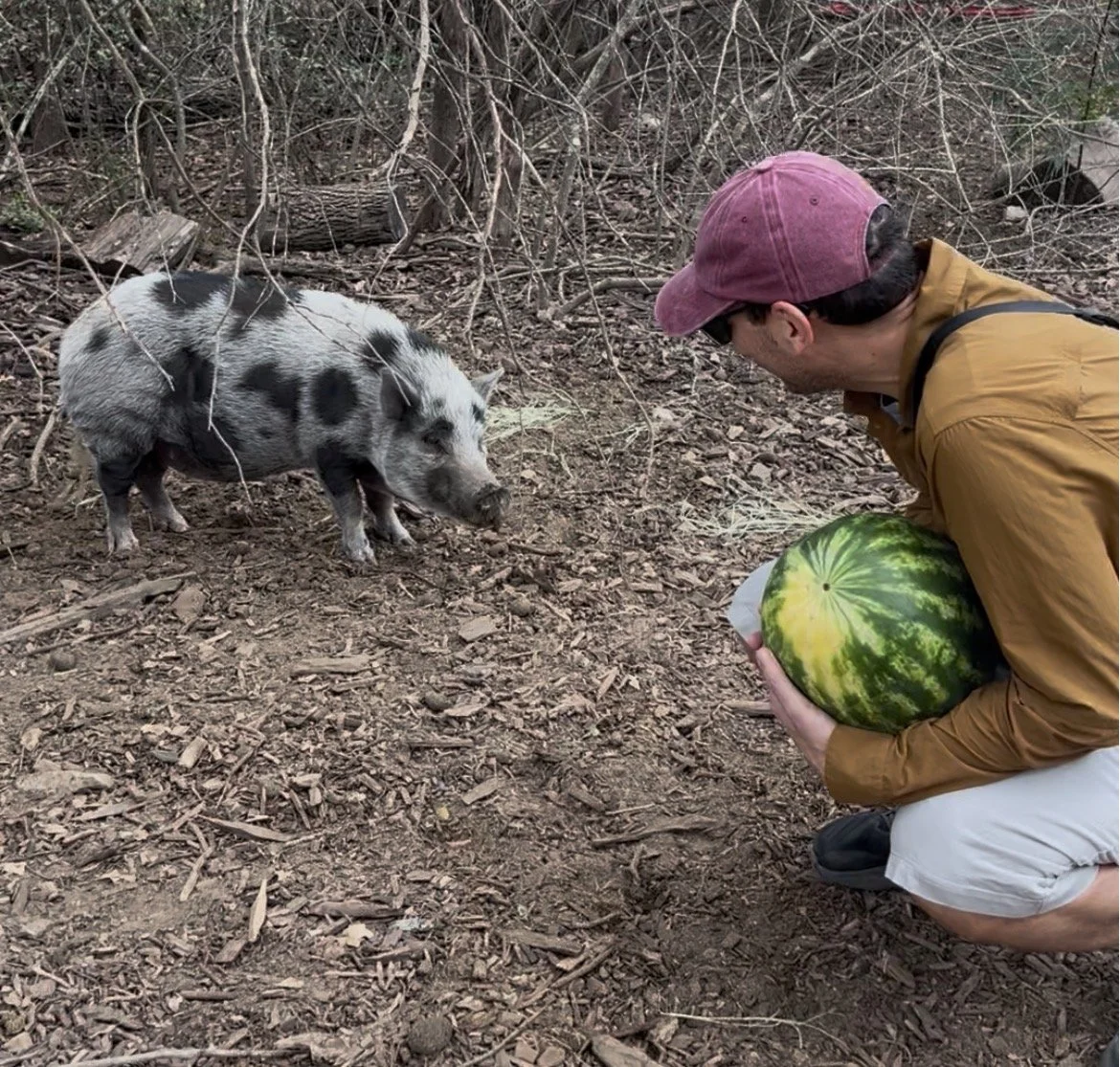
Of the many pigs my husband and I encountered, one shy female pig particularly stood out. Tucked away behind some branches, she watched the excitement from a distance with a friend by her side, seemingly content to take it all in.
She didn’t miss a beat when the watermelons came out, though, and her tail wagged as she alternated between treats. (Carrots and bananas were on the menu, too.)
As we were getting ready to leave, we watched as she successfully guarded her banana from an encroaching neighbor. She quietly grabbed it and trotted off to enjoy it in peace.

We learned that her name was Joni, and that she was rescued from a cruelty and neglect case in 2016 - making her at least ten years old. We also learned that she has always been quite reserved, often staying back from the crowd. (Side note: I was amazed by the CTPR director’s recall of every resident’s name and personality. With more than 200 pigs living in different “neighborhoods” within the sanctuary, it was one of many signs of how dedicated their team is and just how much these animals are loved.)
Becoming “Intimately United with All That Exists”

Interacting with farmed animals can inspire a new way of seeing them. In Laudato Si’, Pope Francis wrote, “If we feel intimately united with all that exists, then sobriety and care will well up spontaneously.” Sanctuaries offer a rare opportunity for that kind of growth.
Since expanding my concern to animals I once disregarded - and recognizing how my disregard was learned and illogical - I’ve also been fascinated by research into animal sentience. Pigs offer a treasure trove of remarkable findings. They are fast learners and problem solvers. They can feel empathy for their peers. They’ve shown self-agency and even outperformed dogs in operating a video game joystick to guide a cursor on-screen and earn rewards.

They also have incredible memories – of other pigs, of humans, and of their experiences, as we heard at the sanctuary. One example that has stuck with me is from a study cited in Farm Sanctuary’s The Someone Project. Pigs were exposed to a crate that would confine them for 30 minutes, versus one that would confine them for four hours. When forced to enter one of the two crates again, they consistently chose the one that would hold them for the least amount of time.
That finding is painful to consider alongside the realities of modern animal agriculture. The Sentience Institute estimates that 98.6 percent of pigs raised for food in the United States are raised on factory farms, where confinement is routine and where their lives are typically measured in months, not years.
The more we learn about animals, the harder it becomes to justify treating them as though their experiences do not matter. And still, pigs shouldn’t have to operate a joystick, solve a problem, or prove themselves to earn our concern. As Catholics, we are called to recognize them as fellow creatures of God, to treat them with kindness, and to reject their needless suffering and death. With so many alternatives available today, we have more opportunities than ever to answer this call.
A New Season of Life
At Central Texas Pig Rescue and sanctuaries around the country, animals have the chance to express the behaviors God gave them, live out their natural lifespans, and experience the abundant world around them. Far from places of exploitation and death, they are surrounded instead by compassion and life.
As we close out summer and usher in a new season, so will they. Joni and the other rescued animals will get to feel the sun on their backs, explore their surroundings, roam and root, and simply be themselves. As creatures meant to share our common home, they finally can.